Stephen Miller, White House Deputy Chief of Staff for Policy, was interviewed on CNN’s The Lead on 5 January. Asked if the US was really serious about running Venezuela, he replied:
‘What the President said is true. The United States of America is running Venezuela. By definition that’s true. We live in the real world, that is governed by strength, that is governed by force, that is governed by power. These are the iron laws of the world since the beginning of time.
‘What I’m saying is that by definition we are in charge because we have the United States military stationed outside the country. We set the terms and conditions. We have a complete embargo on all of their oil and their ability to do commerce. So for them to do commerce, they need our permission. For them to be able to run the economy, they need our permission.’
Transcribed from Novara Media Live podcast, 6 January, with Steven Methan and Kieran Andreu.
American economist and UN adviser Jeffrey Sachs delivered a scorching attack on US actions at the emergency UNSC meeting on Venezuela on 5 January, urging the Security Council to defend international law. The issue,’ he said, is not the character of the government of Venezuela’.
The issue is whether any UN member state has the right to determine Venezuela’s political future or to exercise control over its affairs. Sachs urged the UNSC to uphold, not abandon, the foundational principles of territorial integrity and political independence enshrined in the Charter.
The world’s leading nations had failed to defend international law in the 1930s, Sachs said, leading to renewed global war. The United Nations emerged from that catastrophe as the second attempt to put international law above international anarchy.
‘Given that we are in the nuclear age, failure cannot be repeated. Humanity would perish. There would be no third chance.’
Quoting the introduction to the Charter – the UN was created ‘to save succeeding generations from the scourge of war, which twice in our lifetime has brought untold sorrow to mankind – Sachs argued: ‘Given that we are in the nuclear age, failure cannot be repeated. Humanity would perish. There would be no third chance.’
All member states should refrain from unilateral threats, coercive measures, or armed actions undertaken outside the authority of the UN Security Council. Sachs concluded that to fulfil its responsibilities under the Charter, the Security Council should immediately affirm the following actions:
The United States shall:
immediately cease and desist from all explicit and implicit threats or use of force against Venezuela
terminate its naval quarantine and all related coercive military measures undertaken in the absence of authorization by the UN Security Council
immediately withdraw its military forces from within and along the perimeter of Venezuela, including intelligence, naval, air, and other forward-deployed assets positioned for coercive purposes.
Venezuela shall adhere to the UN Charter and to the human rights protected in the Universal Declaration of Human Rights.
Sach’s recommend, the UN Secretary General should appoint a special envoy to engage relevant Venezuelan and international stakeholders, who would report back to the Security Council making recommendations consistent with the Charter.
All member states should refrain from unilateral threats, coercive measures, or armed actions undertaken outside the authority of the UN Security Council.
Peace and the survival of humanity depend on whether the UN Charter remains a living instrument of international law or is allowed to wither into irrelevance, he concluded. That is the choice before this Council today.
Watch Jeffrey Sachs full speech below, courtesy of DMR News
Early in the morning of Saturday 3 January, the US military led an air and land attack in and around Venezuela’s capital city Caracas and elsewhere, including on civilian targets. This resulted in the kidnap of President Nicolas Maduro, who is now held in the United States. He said in his press conference that the US intends to
President Trump claimed the Maduro government lacked legitimacy, and that the US acted to prevent drug trafficking backed by Maduro, whom Trump says will now faces charges in the US. During his press conference following the kidnap, Trump offered another ‘justification’, citing Venezuela’s nationalisation of oil assets held by US firms in 2007 by which then President Hugo Chávez consolidated state control of Venezuela’s oil industry.
At his press conference following the attack, Trump said the US will ‘run’ Venezuela until a ‘safe, proper and judicious transition’ can be ensured. US oil companies, he said, would also fix Venezuela’s broken infrastructure and ‘start making money for the country’.
Trump’s actions – in breach of international law and disregard of the United Nations Charter – have brought expressions of concern across the world, and in many cases outright condemnation. Prime Minister of Slovakia, Robert Fico hit the nail on the head with his response: ‘US military action in Venezuela is further evidence of the breakdown of the world order created after World War II.’
Britain’s response
Prime Minister Keir Starmer emphasised the UK was not involved in the attack, but refused to be drawn on the legality of the military operation and kidnap. Seeking to hedge his bets he said: ‘I want to establish the facts first. I want to speak to President Trump.’
MPs, trade unionists, and other leading figures have expressed clear opposition to the attack, including CND and Stop the War. which are supporting Venezuela’s emergency online rally (details at the end of this post). You will find many of the expressions of oppositin to Trump’s attack and regime change on Labour CND’s X account. Labour Hub has also posted a round-up of comments.
Labour CND says:
contact your MP to speak out against Trump’s attack
join the emergency protests being organised against US action.
Latin American reactions
The blatant attack on Venezuelan sovereignty threatens to destabilise the region, and puts the 1967 Treaty of Tlatelolco under threat. This is a long-standing nuclear free zone agreement covering Latin America and the Caribbean, that was successfully promoted by Mexico in response to the Cuban Missile Crisis.
Brazil, Uruguay, and Chile, have issued statements condemning the action, but others were cautious. An early statement from President Gustavo Petro of Colombia focused on the possible effect of military action against its neighbour, expressing ‘deep concern at reports of explosions and unusual air activity in recent hours in the Bolivarian Republic of Venezuela, as well as the resulting escalation of tension in the region’.
Columbia could face spillover in violence and possibly an influx of refugees. Following an emergency national security meeting, the Colombian government condemned ‘the attack on the sovereignty of Venezuela and Latin America, and mobilised state forces to secure the border.
Kamla Persad-Bissessar Prime Minister of Trinidad &Tobago, was swift to point out her country’s non-involvement: ‘Trinidad and Tobago is not a participant in any of these ongoing military operations. Trinidad and Tobago continues to maintain peaceful relations with the people of Venezuela.’
Brazil – President Lula Da Silva said: ‘The bombings on Venezuelan territory and the capture of its president cross an unacceptable line. These acts represent a grave affront to Venezuela’s sovereignty and yet another extremely dangerous precedent for the entire international community. Attacking countries in flagrant violation of international law is the first step toward a world of violence, chaos, and instability, where the law of the strongest prevails over multilateralism.’
Uruguay – the Foreign Ministry statement said: ‘Uruguay rejects, as it always has, military intervention by one country in the territory of another and reaffirms the importance of respecting international law and the UN Charter, in particular the basic principle that States must refrain from resorting to the threat or use of force against the territorial integrity or political independence of any State, or in any other manner inconsistent with the Purposes of the United Nations.’
Chile – President Gabriel Boric said: ‘As the Government of Chile, we express our concern and condemnation of the military actions of the United States in Venezuela and call for a peaceful solution to the serious crisis affecting the country.’
International responses
A spokesperson for UN Secretary-General Antonio Guterres said: ‘These developments constitute a dangerous precedent. The Secretary-General continues to emphasize the importance of full respect – by all – of international law, including the UN Charter. He’s deeply concerned that the rules of international law have not been respected.’
The world has divided on predictable lines over Trump’s attack on Venezuelan sovereignty, as the selection of responses below suggests. This further reinforces the view that the post-WWII settlement is rapidly disintegrating.
South Africa. The Department of International Relations said: ‘South Africa calls on the UN Security Council, the body mandated to maintain international peace and security, to urgently convene to address this situation.’
China – the Chinese Foreign Ministry statement said: ‘China is deeply shocked by and strongly condemns the U.S.’s blatant use of force against a sovereign state and action against its president. Such hegemonic acts of the U.S. seriously violate international law and Venezuela’s sovereignty, and threaten peace and security in Latin America and the Caribbean region. China firmly opposes it.Such hegemonic acts of the U.S. seriously violate international law and Venezuela’s sovereignty, and threaten peace and security in Latin America and the Caribbean region.’
Russia – the Foreign Ministry issued a statement: ‘This morning, the United States committed an act of armed aggression against Venezuela. This is deeply concerning and condemnable. The pretexts used to justify such actions are unfounded. Ideological animosity has prevailed over business pragmatism and the willingness to build relationships based on trust and predictability. In the current situation, it is important, first and foremost, to prevent further escalation and to focus on finding a way out of the situation through dialogue.’
Israel – The Times of Israel reports ‘Prime Minister Benjamin Netanyahu congratulated Trump and effusively praise him following the capture of Maduro. Netanyahu hailed Trump’s ‘bold and historic leadership on behalf of freedom and justice’. Netanyahu said: ‘I salute your decisive resolve and the brilliant action of your brave soldiers.’
Unsurprisingly, facing threats of another US military attacks, the Iran Foreign Ministry condemned the attack on Venezuela ‘as a blatant violation of its national sovereignty and territorial integrity’ and called on the UN Security Council to ‘act immediately to halt the unlawful aggression’ and hold those responsible accountable.
EU statements acquiesce in Trump’s action. Take that of European Council President Ursula Von Der Leyen: ‘Following very closely the situation in Venezuela. We stand by the people of Venezuela and support a peaceful and democratic transition. Any solution must respect international law and the UN Charter.’ The German Foreign Ministry statement is in similar vein:
‘We call on all involved parties to avoid an escalation of the situation and to seek ways for a political settlement… International law has to be respected… Venezuelans deserve a peaceful and democratic future.’
It is important to note though, that several European countries have condemned the attack on Venezuela:
France – Foreign Minister Jean-Noel Barrot said: ‘The military operation that led to the capture of Nicolas Maduro violates the principle of not resorting to force, that underpins international law. France reiterates that no lasting political solution can be imposed from the outside and that only sovereign people themselves can decide their future.’
Austria – Vice Chancellor Andreas Babler said: ‘This attack constitutes a serious violation of the prohibition of the use of force enshrined in the UN Charter… We must uphold the international rule of law.’
Spain – the Spanish Foreign Ministry said: ‘Spain calls for de-escalation and moderation, and for action to always be taken in accordance with international law and the principles of the UN Charter.’
Slovakia – President Peter Pellegrini said ‘any attack on a sovereign state and its representative without a mandate from the United Nations Security Council constitutes a serious violation of international law regardless of the regime governing the targeted country. Such actions create a precedent that may destabilize other regions of the world as well.’
Serbia – President Aleksandar Vu?i? hoped attacks on Venezuela will cease and expressed interest in peace and diplomatic resolution amid international tensions. Escalation should be avoided and stability restored, he said.
Slovenia – Prime Minister Robert Golob said any military intervention not based on international law ‘is unacceptable and leads the world into a further spiral of war and violence,’
Belarus – A spokesperson for President Alexander Lukashenko said: ‘The President of Belarus categorically condemns the act of American aggression against Venezuela.’
Opposition within the US
Senator Bernie Sanders said: ‘Trump should address these major crises at home and end his illegal military adventurism abroad.’ His full statement is posted on X.
Newly-inaugurated New York City Mayor Zohran Mamdani described the attack as ‘an act of war and a violation of federal and international law. This blatant pursuit of regime change doesn’t just affect those abroad, it directly impacts New Yorkers, including tens of thousands of Venezuelans who call this city home.’
New York Democratic governor Kathy Hochul described the attack as ‘a flagrant abuse of power by acting without congressional approval’.
Democratic Representative Alexandria Ocasio-Cortez said: ‘It’s not about drugs. If it was, Trump wouldn’t have pardoned one of the largest narco-traffickers in the world last month. It’s about oil and regime change.’
Congressional Progressive Caucus chair, Greg Casar wrote: ‘Trump has no right to take us to war with Venezuela. This is reckless and illegal. Congress should vote immediately on a War Powers Resolution to stop him.’
WHAT YOU CAN DO
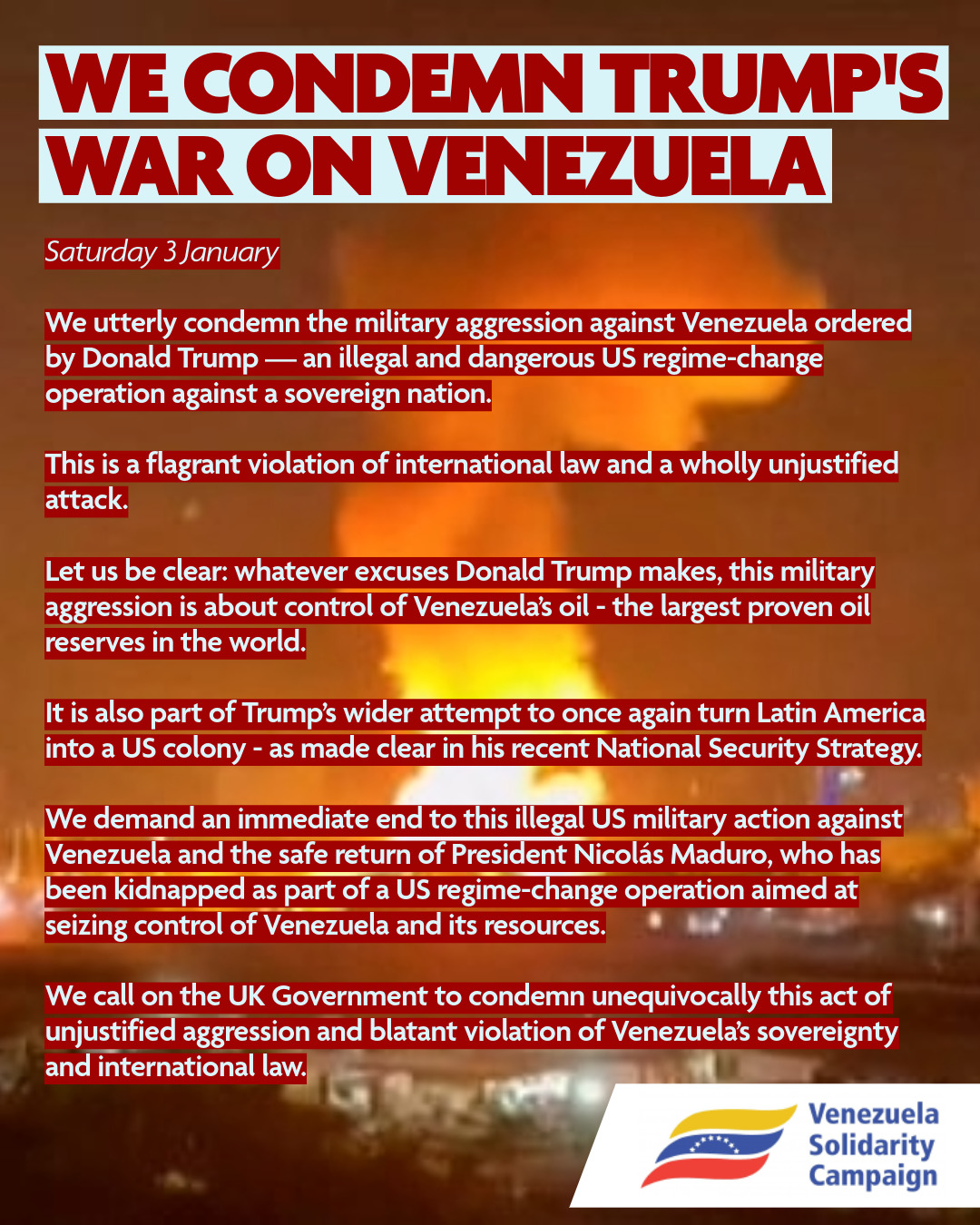
Circulate the Venezuela Solidarity Campaign statement below, and visit VSC website for updates
Register to join the emergency online rally at 6pm on Sunday 4 January, organised by VSC, supported by CND and STW
If you can get to London, take part in the protest at Downing Street at 6pm on Monday 5 January, and check out protests in your locality
Lobby your MP to speak out against Trump’s attack on Venezuela.
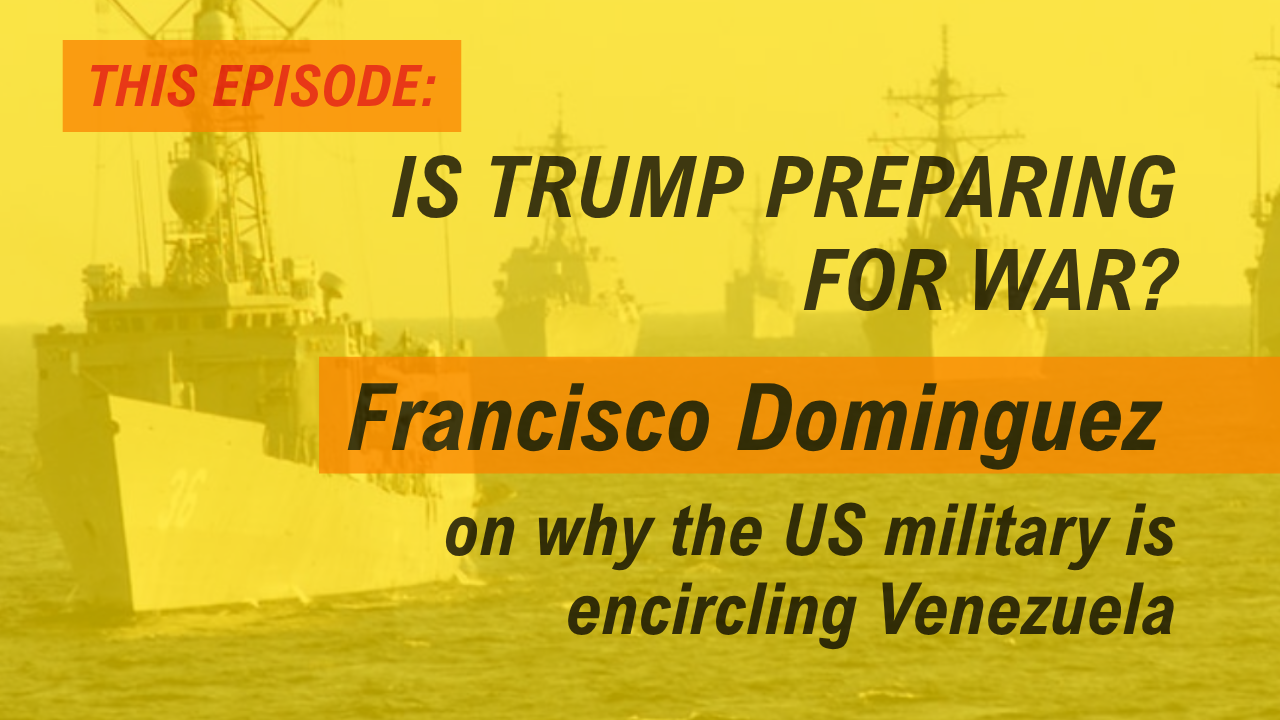
For more about the background to this attack, see Labour CND’s podcast, Is Trump Preparing for War? with VSC Secretary Francisco Dominguez, also available on YouTube and Spotify.
In Labour CND’s latest podcast, Francisco Dominguez talks to Carol Turner about Trump’s military encirclement of Venezuela, and the Treaty of Tlatelolco, the Latin America-Caribbean nuclear free zone agreement of 1967 promoted by Mexico in response to the Cuban Missile Crisis.
Our podcasts are available on Spotify, YouTube, and FB. Give us a listen, and if you like what you hear, give us a follow and please tell you friends. Back episodes include:
Andrew Murray on the TUC 2025 agenda
Sam Mason on the military bootprint astride the climate crisis
Alex Gordon on the defence jobs myth, and
Defence Economist Ron Smith on military spending and the Chancellor’s spring statement.